
What Is Generative AI Optimization?
Generative AI Optimization (GAIO) is a strategic process that enhances your brand’s content visibility and user interaction within Generative Search Engines (GSEs). AI-driven platforms like Google’s Search Generative Experience (SGE), ChatGPT Browse, or Perplexity AI.
Unlike traditional SEO, GAIO focuses on semantic alignment between AI-generated answers and the contextual authority of your content.
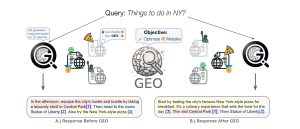
From SEO to GEO: How Generative Search Is Redefining Discovery
Traditional SEO relies on ranking pages; GEO (Generative Engine Optimization) focuses on being referenced inside an AI’s synthesized answer.
That means topical authority, entity clarity, and responsiveness now outweigh simple keyword density.
| SEO Era | Core Focus | Optimization Goal | Example |
| Web 1.0 | Keywords | Rank by term frequency | “Buy shoes online.” |
| Web 2.0 | User Intent | Rank by search intent | “Best running shoes for flat feet” |
| Web 3.0 | Entities & Context | Rank by entity authority | Brand & topic clusters |
| Web 4.0 (Now) | Generative Relevance | Be featured in AI-generated results | Cited in SGE or ChatGPT |
Generative SEO = Authority + Relevance + Contextual Confidence.
The Semantic Core: How AI Understands and Ranks Content
According to the Koray framework, AI engines interpret data through semantic relationships, not just text relevance.
That’s why macro-context, micro-semantics, and entity–attribute–value (EAV) connections determine visibility.
Core Semantic Layers:
- Macro-semantics: Site-wide entity consistency (e.g., “Generative AI” appears in headings, schema, and visuals).
- Micro-semantics: Sentence-level optimization, verb choices, predicate meaning, and co-occurrence patterns.
- Contextual Flow: Logical hierarchy of ideas from “definition → mechanics → strategy → tools”.
- Contextual Bridge: Linking AI optimization with content marketing, creating topical continuity across slash.co.
Why GAIO Matters for Brands
Generative AI systems now act as information brokers, not just search intermediaries.
They curate, summarize, and rank trusted entities, rewarding pages that demonstrate:
- Strong entity identity (brand as a known node),
- Deep topical coverage, and
- User behavior signals (positive historical data).
Key Benefits:
- Enhanced brand visibility within AI-generated results.
- Better contextual recognition in voice and chat searches.
Improved organic traffic via query expansion across entity clusters.
How to Optimize for Generative Engines
| Step | Strategy | Semantic Purpose |
| 1 | Identify your central entity (e.g., your brand) | Defines contextual identity |
| 2 | Create a topical map around GAIO | Expands topical authority |
| 3 | Optimize macro-context (headings, schema, visuals) | Aligns entity relationships |
| 4 | Refine micro-semantics | Increases retrieval clarity |
| 5 | Build content bridges between related subtopics | Enhances responsiveness |
| 6 | Track historical data & user interactions | Strengthens long-term authority |
🔹 Example: Instead of only writing “How to optimize for generative AI,” expand with entity associations like “AI content optimization tools,” “semantic search alignment,” and “LLM response quality.”
“Generative Engine Optimization is not about gaming AI models; it’s about teaching them to trust you.
Each paragraph, schema, and link must reflect your topical integrity and contextual responsiveness.”
— Ehsan Khan, Semantic SEO Expert & Co-founder of SemanticSEO.Digital
The Future: Predictive Optimization in an LLM World
As LLMs evolve, predictive information retrieval will likely become the dominant approach—where content isn’t just discovered, but anticipated. The shift from reactive SEO to predictive optimization means that search will be less about keywords and more about contextual alignment with user intent, behavior patterns, and even emotion.
Brands must begin to anticipate query semantics, not merely react to them. This involves rethinking how content ecosystems are structured and how data signals are interpreted. Key strategic moves include:
- Building dynamic topical maps that evolve continuously with real-time shifts in search intent, helping brands identify emerging questions before competitors do.
- Using semantic clustering and entity-based optimization to uncover new keyword opportunities that align with both user context and brand authority.
- Training AI-ready content briefs that incorporate multiple layers of intent, informational, transactional, and experiential, enabling scalable, human-centered content creation guided by machine intelligence.
- Integrating behavioral data loops, where insights from user interactions (click paths, dwell time, and generative search responses) inform ongoing content and UX refinements.
- Leveraging LLM fine-tuning on proprietary datasets to create more adaptive, brand-consistent conversational experiences across channels.
Slash.co can lead this transformation by aligning brand communication, content production, and AI interface optimization under a semantic-first strategy. By connecting data, design, and storytelling through predictive intelligence, Slash can help brands build digital ecosystems that not only respond to audience needs but also anticipate them in real-time.
Conclusion
Generative AI Optimization is the next frontier of organic visibility, merging AI linguistics, entity-based search, and semantic SEO engineering.
It’s not about ranking; it’s about being recognized.
Brands that master semantic coverage, entity coherence, and contextual depth will own the AI-generated future.
Frequently Asked Questions (FAQ) Generative AI Optimization (GAIO)
Q1. What’s the difference between SEO and Generative AI Optimization? SEO optimizes for search engine ranking pages; GAIO optimizes for inclusion in AI responses through semantic relationships and entity accuracy.
Q2. How do you measure success in GAIO? Success is reflected in AI citation frequency, SERP generative previews, and the presence of entities within AI summaries.
Q3. Can traditional link building still help in GAIO? Yes, but contextual backlinks that reinforce entity co-occurrence (not just DA) are crucial.
Q4. What role does content freshness play? Publication frequency (momentum) signals relevance to AI systems, influencing their retrieval prioritization.


